


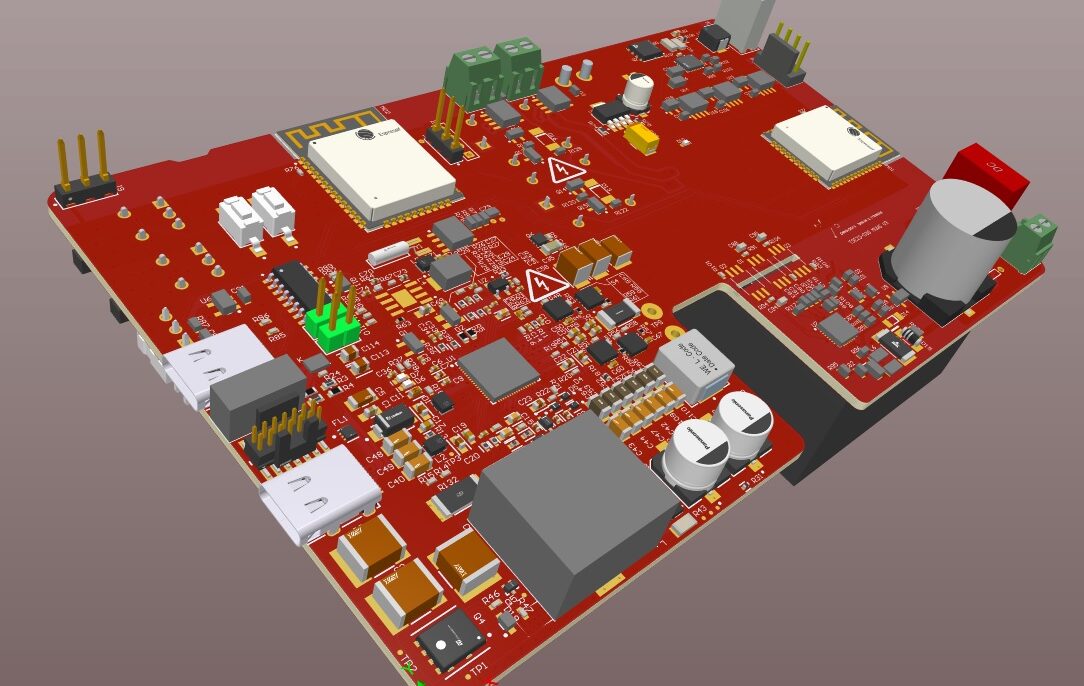

Smart IoT Power & Wireless Charging System
This project is a custom IoT-enabled power and wireless charging system featuring dual ESP32 modules, AC power control with surge protection, USB/USB-C charging, data logging, and a backup battery system. It integrates a Qi wireless charger based on the ST STEVAL-WBC2TX50 design, a capacitive touch interface, and real-time monitoring through Arduino IoT Cloud. The design was developed in Altium, prototyped, and tested to validate performance.
- Client Technology Station in Electronics
- Date 15 June 2022
- Services Electronic Design
This project demonstrates the design and development of a custom IoT-enabled hardware platform that combines power management, wireless charging, data logging, and cloud connectivity in a single system. Built around dual ESP32 modules (one for main control and one as a Wi-Fi range extender), the device integrates multiple advanced features for real-world usability and monitoring.
Key Features
- AC Power Control: Two 220 V AC plugs with surge detection and protection.
- Dual ESP32 Modules:
- Primary ESP32 for Wi-Fi + BLE control and system management.
- Secondary ESP32 configured as a Wi-Fi range extender for reliable connectivity.
- Wireless Charging: Integrated Qi-based 5 W transmitter, developed from the ST STEVAL-WBC2TX50 reference design and customized to fit seamlessly with the system.
- Energy Storage & Backup: Built-in rechargeable battery backup system with charge monitoring.
- USB Power Outputs: Standard USB-A and USB-C charging ports with current sensing for monitoring charge profiles.
- Capacitive Touch Interface: User-friendly and modern touch-based control system.
- Data Logging & Real-Time Monitoring:
- SD card for local data storage.
- RTC (Real-Time Clock) for timestamping events.
- Live system monitoring and control through Arduino Cloud IoT integration.


My Contribution
System Architecture: Defined the hardware block diagram and integrated all sub-systems (power, wireless charging, data logging, and connectivity).
Schematic & PCB Design: Captured schematics and created multilayer PCB layouts in Altium Designer, with careful attention to isolation, safety, and EMI considerations.
Hardware Integration: Customized the wireless charging circuit from the ST reference design and integrated it with the rest of the hardware.
Testing & Validation:
- Conducted functional testing using an oscilloscope to verify power paths, wireless charging behavior, and surge detection.
- Validated cloud connectivity by linking to Arduino IoT Cloud for remote control and data visualization.
Prototype to Testing Stage: Took the design from Altium simulations and PCB fabrication to physical testing and debugging, ensuring reliable performance.
Learning Outcome
This project deepened my expertise in embedded hardware design, IoT system integration, and wireless power electronics. It also demonstrated my ability to combine reference designs with custom hardware, ensuring all subsystems — power, data logging, cloud connectivity, and wireless charging — worked together in a cohesive IoT solution.