ESP32-Based IoT Sensor Node / Development Platform.
This project is a battery-powered ESP32 IoT sensor node and development platform, designed with exposed GPIOs for sensor integration, a DC-DC converter for efficient power regulation, and dual Wi-Fi/BLE connectivity. Manufactured in 10 units, it serves as a versatile platform for prototyping IoT applications such as environmental monitoring and portable data logging.
This project showcases the design of a battery-powered IoT sensor node and development platform, built around the ESP32 for dual Wi-Fi and Bluetooth Low Energy (BLE) connectivity. The board was manufactured in a batch of 10 units for evaluation and prototyping. Designed to be compact yet flexible, it allows integration with a wide range of sensors and peripherals through exposed GPIO pins.
Key Features
ESP32 SoC with Wi-Fi + BLE connectivity for cloud and local communication.
Battery-Powered Operation with a high-efficiency DC-DC converter for stable system supply.
Exposed GPIO Interfaces to connect sensors, actuators, and other external peripherals.
Modular Design enabling use in multiple IoT applications (e.g., environmental monitoring, smart home devices, or portable data logging).
Prototyping & Scalability: Board can be used as both a standalone IoT node or a development platform for further system integration.
My Contribution
Designed the schematic and multilayer PCB in Altium Designer, optimizing layout for power efficiency and modularity.
Implemented battery power management and integrated a DC-DC converter to provide stable voltages for ESP32 and connected devices.
Exposed key GPIO pins for sensor and peripheral interfacing.
Oversaw manufacturing of 10 prototypes, validating the design from fabrication to functional testing.
Conducted hardware testing of communication, power management, and GPIO expandability.
Learning Outcome
This project deepened my expertise in embedded IoT hardware design, battery power systems, and modular PCB development. It also demonstrated my ability to design and deliver a small-batch production run of hardware suitable for real-world testing and prototyping.
Close op portrait of confident woman with red lips
Through a wide variety of mobile applications, we’ve developed a unique visual system and strategy that can be applied across the spectrum of available applications.
Lorem ipsum dolor sit amet, consectetur adipiscing elit, sed do eiusmod tempor incididunt ut labore et dolore magna aliqua. Quis ipsum suspendisse ultrices gravida. Risus commod viverra maecenas accumsan lacus vel facilisis. ut labore et dolore magna aliqua.
There are always some stocks, which illusively scale lofty heights in a given time period. However, the good show doesn’t last for these overblown toxic stocks as their current price is not justified by their fundamental strength.
Toxic companies are usually characterized by huge debt loads and are vulnerable to external shocks. Accurately identifying such bloated stocks and getting rid of them at the right time can protect your portfolio.
Overpricing of these toxic stocks can be attributed to either an irrational enthusiasm surrounding them or some serious fundamental drawbacks. If you own such bubble stocks for an inordinate period of time, you are bound to see a massive erosion of wealth.
However, if you can precisely spot such toxic stocks, you may gain by resorting to an investing strategy called short selling. This strategy allows one to sell a stock first and then buy it when the price falls.
While short selling excels in bear markets, it typically loses money in bull markets.
So, just like identifying stocks with growth potential, pinpointing toxic stocks and offloading them at the right time is crucial to guard one’s portfolio from big losses or make profits by short selling them. Heska Corporation HSKA, Tandem Diabetes Care, Inc. TNDM, Credit Suisse Group CS,Zalando SE ZLNDY and Las Vegas Sands LVS are a few such toxic stocks.Screening Criteria
Through a wide variety of mobile applications, we’ve developed a unique visual system and strategy that can be applied across the spectrum of available applications.
So, just like identifying stocks with growth potential, pinpointing toxic stocks and offloading them at the right time is crucial to guard one’s portfolio from big losses or make profits by short selling them.
Heska Corporation HSKA, Tandem Diabetes Care, Inc. TNDM, Credit Suisse Group CS,Zalando SE ZLNDY and Las Vegas Sands LVS are a few such toxic stocks.Screening Criteria
Through a wide variety of mobile applications, we’ve developed a unique visual system and strategy that can be applied across the spectrum of available applications.
Lorem ipsum dolor sit amet, consectetur adipiscing elit, sed do eiusmod tempor incididunt ut labore et dolore magna aliqua. Quis ipsum suspendisse ultrices gravida. Risus commod viverra maecenas accumsan lacus vel facilisis. ut labore et dolore magna aliqua.
There are always some stocks, which illusively scale lofty heights in a given time period. However, the good show doesn’t last for these overblown toxic stocks as their current price is not justified by their fundamental strength.
Toxic companies are usually characterized by huge debt loads and are vulnerable to external shocks. Accurately identifying such bloated stocks and getting rid of them at the right time can protect your portfolio.
Overpricing of these toxic stocks can be attributed to either an irrational enthusiasm surrounding them or some serious fundamental drawbacks. If you own such bubble stocks for an inordinate period of time, you are bound to see a massive erosion of wealth.
However, if you can precisely spot such toxic stocks, you may gain by resorting to an investing strategy called short selling. This strategy allows one to sell a stock first and then buy it when the price falls.
While short selling excels in bear markets, it typically loses money in bull markets.
So, just like identifying stocks with growth potential, pinpointing toxic stocks and offloading them at the right time is crucial to guard one’s portfolio from big losses or make profits by short selling them. Heska Corporation HSKA, Tandem Diabetes Care, Inc. TNDM, Credit Suisse Group CS,Zalando SE ZLNDY and Las Vegas Sands LVS are a few such toxic stocks.Screening Criteria
Through a wide variety of mobile applications, we’ve developed a unique visual system and strategy that can be applied across the spectrum of available applications.
Lorem ipsum dolor sit amet, consectetur adipiscing elit, sed do eiusmod tempor incididunt ut labore et dolore magna aliqua. Quis ipsum suspendisse ultrices gravida. Risus commod viverra maecenas accumsan lacus vel facilisis. ut labore et dolore magna aliqua.
There are always some stocks, which illusively scale lofty heights in a given time period. However, the good show doesn’t last for these overblown toxic stocks as their current price is not justified by their fundamental strength.
Toxic companies are usually characterized by huge debt loads and are vulnerable to external shocks. Accurately identifying such bloated stocks and getting rid of them at the right time can protect your portfolio.
Overpricing of these toxic stocks can be attributed to either an irrational enthusiasm surrounding them or some serious fundamental drawbacks. If you own such bubble stocks for an inordinate period of time, you are bound to see a massive erosion of wealth.
However, if you can precisely spot such toxic stocks, you may gain by resorting to an investing strategy called short selling. This strategy allows one to sell a stock first and then buy it when the price falls.
While short selling excels in bear markets, it typically loses money in bull markets.
So, just like identifying stocks with growth potential, pinpointing toxic stocks and offloading them at the right time is crucial to guard one’s portfolio from big losses or make profits by short selling them. Heska Corporation HSKA, Tandem Diabetes Care, Inc. TNDM, Credit Suisse Group CS,Zalando SE ZLNDY and Las Vegas Sands LVS are a few such toxic stocks.Screening Criteria
Through a wide variety of mobile applications, we’ve developed a unique visual system and strategy that can be applied across the spectrum of available applications.
Lorem ipsum dolor sit amet, consectetur adipiscing elit, sed do eiusmod tempor incididunt ut labore et dolore magna aliqua. Quis ipsum suspendisse ultrices gravida. Risus commod viverra maecenas accumsan lacus vel facilisis. ut labore et dolore magna aliqua.
There are always some stocks, which illusively scale lofty heights in a given time period. However, the good show doesn’t last for these overblown toxic stocks as their current price is not justified by their fundamental strength.
Toxic companies are usually characterized by huge debt loads and are vulnerable to external shocks. Accurately identifying such bloated stocks and getting rid of them at the right time can protect your portfolio.
Overpricing of these toxic stocks can be attributed to either an irrational enthusiasm surrounding them or some serious fundamental drawbacks. If you own such bubble stocks for an inordinate period of time, you are bound to see a massive erosion of wealth.
However, if you can precisely spot such toxic stocks, you may gain by resorting to an investing strategy called short selling. This strategy allows one to sell a stock first and then buy it when the price falls.
While short selling excels in bear markets, it typically loses money in bull markets.
So, just like identifying stocks with growth potential, pinpointing toxic stocks and offloading them at the right time is crucial to guard one’s portfolio from big losses or make profits by short selling them. Heska Corporation HSKA, Tandem Diabetes Care, Inc. TNDM, Credit Suisse Group CS,Zalando SE ZLNDY and Las Vegas Sands LVS are a few such toxic stocks.Screening Criteria
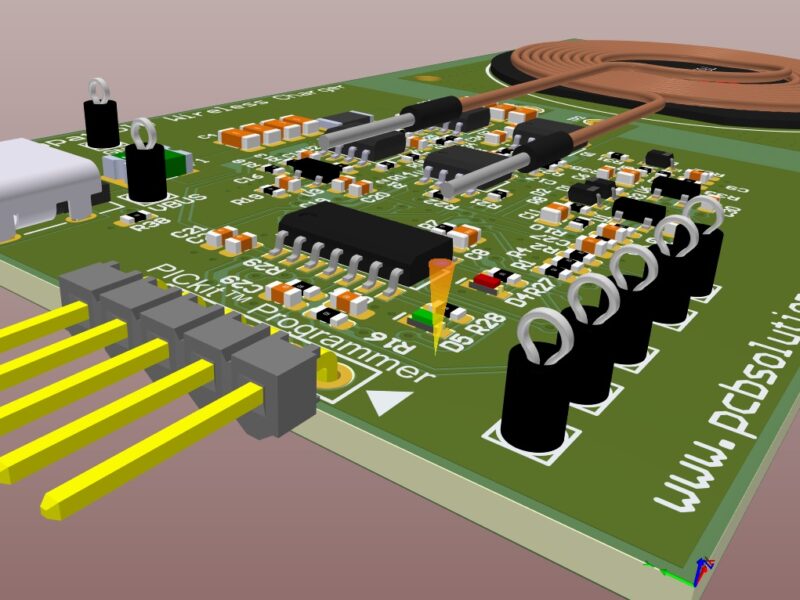
This project features a wireless charger, adapted from a Microchip reference design. It uses a resonant coil with microcontroller-based control to deliver efficient wireless charging with built-in safety features.
The 5 W Qi-compatible wireless charger delivers efficient wireless power transfer using a resonant coil and microcontroller-based control, it also has built-in safety features. This project gave me hands-on experience in wireless power electronics and improved my PCB design skills.
Design
This wireless charger uses a resonant coil and a power stage controlled by a microcontroller to deliver efficient wireless power transfer while meeting the Qi standard. The design includes safety features, making it practical and robust.
Client
Andy Grove
This project presents a 5 W Qi wireless power transmitter, inspired by Microchip’s Qi 5W wireless transmitter reference design. I adapted this design to create a custom version suitable for demonstration and proof-of-concept. The transmitter is fully compatible with the Qi standard and is optimized for cost-efficient, safe, and reliable wireless power transfer up to 5 W. The design goals include maintaining high efficiency, ensuring robust foreign-object detection (FOD), and providing full software control of the power and communication loop.
Core System Architecture
Input & Power Stage: Accepts a 5 V input (e.g. from USB-C or standard 5 V adapter), converting it via a power stage (H-bridge or half-bridge) to drive the resonant coil. The design supports a working frequency range (approx. 110 kHz to 205 kHz) with distributed capacitance (DCY) compensation to maintain resonance and efficiency. Microchip
Resonant Coil & Matching Network: A transmitting coil tuned with series/parallel capacitors to form a resonant tank. It couples magnetically to the receiver coil in the end device. Proper tuning, layout, and shielding are critical to reduce losses and maintain stability.
Control & Communication: The Qi state machine, FOD detection, and control loops are handled in firmware. In the reference, a PIC16F (or equivalent) microcontroller runs the state machine and monitors feedback to regulate power. Microchip
Protection & Regulation: Safety features such as over-current, over-temperature, and thermal shut-off are included. FOD (foreign object detection) is implemented such that the threshold scales with transmitter power. Microchip
Efficiency & Performance: The reference target is over 70% transfer efficiency in many real-world conditions.
What I did and Learned
I used the Microchip reference design as a foundation for learning and adaptation, not as a black box: I studied the reference schematic and documentation closely, then reimplemented and modified as needed for my own version.
I created custom schematics and PCB layouts, optimizing component placement, trace routing (especially in the resonant and high-current paths), and layout constraints for EMI suppression.
I annotated and explained critical functional blocks in my documentation (e.g. resonant tank, FOD detection circuit, microcontroller interface), highlighting where design trade-offs occur (efficiency vs safety, layout vs stray capacitance).
I measured and validated performance (e.g. power transferred at different coil separations, thermal behavior, FOD response) to compare with theoretical expectations.
I documented deviations or enhancements I made (e.g. alternative component choices, layout tweaks, optional features) and discussed how the design might scale or be improved further (e.g. higher power levels, multi-coil, alignment aids).
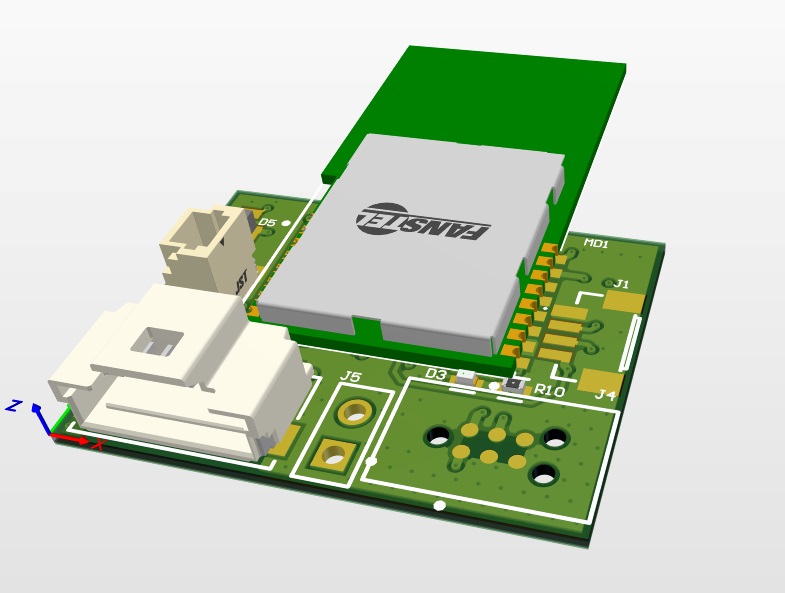
This project is a battery-powered IoT device based on the Fastel BT840X (nRF52840) with USB-C charging and an 8-pin connector for external peripherals. Designed for low-power operation and BLE connectivity, it was developed in Altium and manufactured as a compact prototype for real-world IoT applications.
This project showcases the design of a battery-powered IoT device built around the Fanstel BT840X module, which integrates the Nordic nRF52840 SoC with Bluetooth 5.0 capabilities. The board was designed for low-power operation, rechargeable over USB-C, and supports external connectivity through an 8-pin interface for switches and peripherals. With its compact and modular design, the device can be adapted for a variety of IoT applications such as wearables, smart sensors, and portable controllers.
Key Features
Fanstel BT840X Module (nRF52840 SoC) providing BLE 5.0 connectivity.
Battery-Powered Design with integrated USB-C charging.
8-Pin Connector for attaching external switches, sensors, or custom peripherals.
Low-Power Operation suitable for portable and continuous IoT use cases.
Compact PCB Layout optimized for manufacturability and modularity.
My Contribution
Designed the schematic and PCB layout in Altium Designer, ensuring optimized RF performance and stable power delivery.
Implemented battery management and USB-C charging circuitry for reliable portable operation.
Integrated an 8-pin peripheral connector to provide flexible I/O options.
Oversaw the fabrication and assembly of prototypes and carried out functional testing.
Documented system behavior and validated wireless performance in real-world testing.
Learning Outcome
This project expanded my expertise in BLE-based IoT hardware design, battery management systems, and modular peripheral interfacing. It also highlighted my ability to design compact, power-efficient systems ready for integration into real-world IoT solutions.