ESP32-Based IoT Sensor Node / Development Platform.
This project is a battery-powered ESP32 IoT sensor node and development platform, designed with exposed GPIOs for sensor integration, a DC-DC converter for efficient power regulation, and dual Wi-Fi/BLE connectivity. Manufactured in 10 units, it serves as a versatile platform for prototyping IoT applications such as environmental monitoring and portable data logging.
This project showcases the design of a battery-powered IoT sensor node and development platform, built around the ESP32 for dual Wi-Fi and Bluetooth Low Energy (BLE) connectivity. The board was manufactured in a batch of 10 units for evaluation and prototyping. Designed to be compact yet flexible, it allows integration with a wide range of sensors and peripherals through exposed GPIO pins.
Key Features
ESP32 SoC with Wi-Fi + BLE connectivity for cloud and local communication.
Battery-Powered Operation with a high-efficiency DC-DC converter for stable system supply.
Exposed GPIO Interfaces to connect sensors, actuators, and other external peripherals.
Modular Design enabling use in multiple IoT applications (e.g., environmental monitoring, smart home devices, or portable data logging).
Prototyping & Scalability: Board can be used as both a standalone IoT node or a development platform for further system integration.
My Contribution
Designed the schematic and multilayer PCB in Altium Designer, optimizing layout for power efficiency and modularity.
Implemented battery power management and integrated a DC-DC converter to provide stable voltages for ESP32 and connected devices.
Exposed key GPIO pins for sensor and peripheral interfacing.
Oversaw manufacturing of 10 prototypes, validating the design from fabrication to functional testing.
Conducted hardware testing of communication, power management, and GPIO expandability.
Learning Outcome
This project deepened my expertise in embedded IoT hardware design, battery power systems, and modular PCB development. It also demonstrated my ability to design and deliver a small-batch production run of hardware suitable for real-world testing and prototyping.
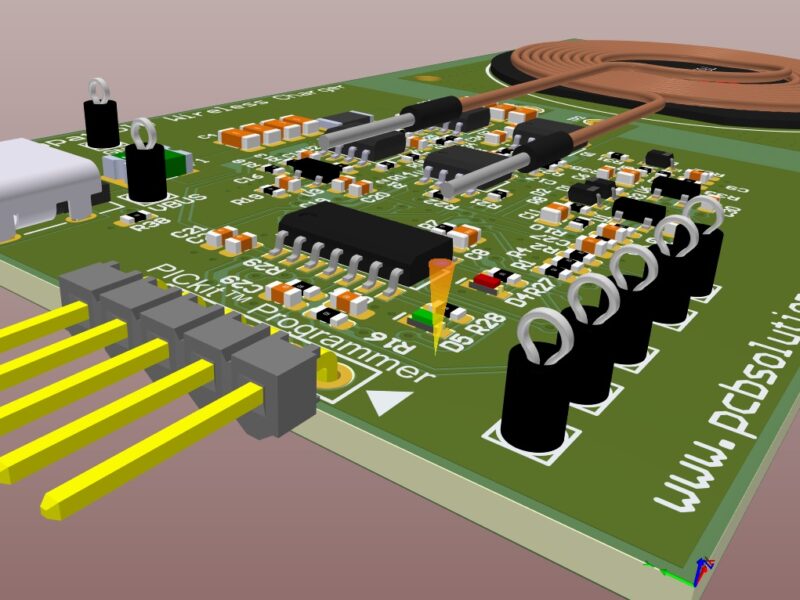
This project features a wireless charger, adapted from a Microchip reference design. It uses a resonant coil with microcontroller-based control to deliver efficient wireless charging with built-in safety features.
The 5 W Qi-compatible wireless charger delivers efficient wireless power transfer using a resonant coil and microcontroller-based control, it also has built-in safety features. This project gave me hands-on experience in wireless power electronics and improved my PCB design skills.
Design
This wireless charger uses a resonant coil and a power stage controlled by a microcontroller to deliver efficient wireless power transfer while meeting the Qi standard. The design includes safety features, making it practical and robust.
Client
Andy Grove
This project presents a 5 W Qi wireless power transmitter, inspired by Microchip’s Qi 5W wireless transmitter reference design. I adapted this design to create a custom version suitable for demonstration and proof-of-concept. The transmitter is fully compatible with the Qi standard and is optimized for cost-efficient, safe, and reliable wireless power transfer up to 5 W. The design goals include maintaining high efficiency, ensuring robust foreign-object detection (FOD), and providing full software control of the power and communication loop.
Core System Architecture
Input & Power Stage: Accepts a 5 V input (e.g. from USB-C or standard 5 V adapter), converting it via a power stage (H-bridge or half-bridge) to drive the resonant coil. The design supports a working frequency range (approx. 110 kHz to 205 kHz) with distributed capacitance (DCY) compensation to maintain resonance and efficiency. Microchip
Resonant Coil & Matching Network: A transmitting coil tuned with series/parallel capacitors to form a resonant tank. It couples magnetically to the receiver coil in the end device. Proper tuning, layout, and shielding are critical to reduce losses and maintain stability.
Control & Communication: The Qi state machine, FOD detection, and control loops are handled in firmware. In the reference, a PIC16F (or equivalent) microcontroller runs the state machine and monitors feedback to regulate power. Microchip
Protection & Regulation: Safety features such as over-current, over-temperature, and thermal shut-off are included. FOD (foreign object detection) is implemented such that the threshold scales with transmitter power. Microchip
Efficiency & Performance: The reference target is over 70% transfer efficiency in many real-world conditions.
What I did and Learned
I used the Microchip reference design as a foundation for learning and adaptation, not as a black box: I studied the reference schematic and documentation closely, then reimplemented and modified as needed for my own version.
I created custom schematics and PCB layouts, optimizing component placement, trace routing (especially in the resonant and high-current paths), and layout constraints for EMI suppression.
I annotated and explained critical functional blocks in my documentation (e.g. resonant tank, FOD detection circuit, microcontroller interface), highlighting where design trade-offs occur (efficiency vs safety, layout vs stray capacitance).
I measured and validated performance (e.g. power transferred at different coil separations, thermal behavior, FOD response) to compare with theoretical expectations.
I documented deviations or enhancements I made (e.g. alternative component choices, layout tweaks, optional features) and discussed how the design might scale or be improved further (e.g. higher power levels, multi-coil, alignment aids).
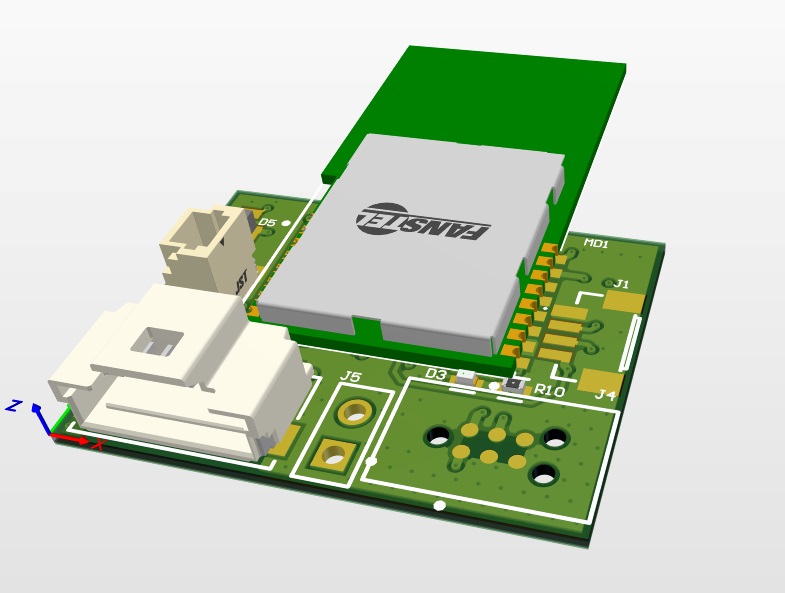
This project is a battery-powered IoT device based on the Fastel BT840X (nRF52840) with USB-C charging and an 8-pin connector for external peripherals. Designed for low-power operation and BLE connectivity, it was developed in Altium and manufactured as a compact prototype for real-world IoT applications.
This project showcases the design of a battery-powered IoT device built around the Fanstel BT840X module, which integrates the Nordic nRF52840 SoC with Bluetooth 5.0 capabilities. The board was designed for low-power operation, rechargeable over USB-C, and supports external connectivity through an 8-pin interface for switches and peripherals. With its compact and modular design, the device can be adapted for a variety of IoT applications such as wearables, smart sensors, and portable controllers.
Key Features
Fanstel BT840X Module (nRF52840 SoC) providing BLE 5.0 connectivity.
Battery-Powered Design with integrated USB-C charging.
8-Pin Connector for attaching external switches, sensors, or custom peripherals.
Low-Power Operation suitable for portable and continuous IoT use cases.
Compact PCB Layout optimized for manufacturability and modularity.
My Contribution
Designed the schematic and PCB layout in Altium Designer, ensuring optimized RF performance and stable power delivery.
Implemented battery management and USB-C charging circuitry for reliable portable operation.
Integrated an 8-pin peripheral connector to provide flexible I/O options.
Oversaw the fabrication and assembly of prototypes and carried out functional testing.
Documented system behavior and validated wireless performance in real-world testing.
Learning Outcome
This project expanded my expertise in BLE-based IoT hardware design, battery management systems, and modular peripheral interfacing. It also highlighted my ability to design compact, power-efficient systems ready for integration into real-world IoT solutions.
This project is a custom IoT-enabled power and wireless charging system featuring dual ESP32 modules, AC power control with surge protection, USB/USB-C charging, data logging, and a backup battery system. It integrates a Qi wireless charger based on the ST STEVAL-WBC2TX50 design, a capacitive touch interface, and real-time monitoring through Arduino IoT Cloud. The design was developed in Altium, prototyped, and tested to validate performance.
This project demonstrates the design and development of a custom IoT-enabled hardware platform that combines power management, wireless charging, data logging, and cloud connectivity in a single system. Built around dual ESP32 modules (one for main control and one as a Wi-Fi range extender), the device integrates multiple advanced features for real-world usability and monitoring.
Key Features
AC Power Control: Two 220 V AC plugs with surge detection and protection.
Dual ESP32 Modules:
Primary ESP32 for Wi-Fi + BLE control and system management.
Secondary ESP32 configured as a Wi-Fi range extender for reliable connectivity.
Wireless Charging: Integrated Qi-based 5 W transmitter, developed from the ST STEVAL-WBC2TX50 reference design and customized to fit seamlessly with the system.
Energy Storage & Backup: Built-in rechargeable battery backup system with charge monitoring.
USB Power Outputs: Standard USB-A and USB-C charging ports with current sensing for monitoring charge profiles.
Capacitive Touch Interface: User-friendly and modern touch-based control system.
Data Logging & Real-Time Monitoring:
SD card for local data storage.
RTC (Real-Time Clock) for timestamping events.
Live system monitoring and control through Arduino Cloud IoT integration.
Manufactured PCBManufactured PCB under oscilloscope testing, validating wireless charging and AC power switching
My Contribution
System Architecture: Defined the hardware block diagram and integrated all sub-systems (power, wireless charging, data logging, and connectivity).
Schematic & PCB Design: Captured schematics and created multilayer PCB layouts in Altium Designer, with careful attention to isolation, safety, and EMI considerations.
Hardware Integration: Customized the wireless charging circuit from the ST reference design and integrated it with the rest of the hardware.
Testing & Validation:
Conducted functional testing using an oscilloscope to verify power paths, wireless charging behavior, and surge detection.
Validated cloud connectivity by linking to Arduino IoT Cloud for remote control and data visualization.
Prototype to Testing Stage: Took the design from Altium simulations and PCB fabrication to physical testing and debugging, ensuring reliable performance.
Learning Outcome
This project deepened my expertise in embedded hardware design, IoT system integration, and wireless power electronics. It also demonstrated my ability to combine reference designs with custom hardware, ensuring all subsystems — power, data logging, cloud connectivity, and wireless charging — worked together in a cohesive IoT solution.